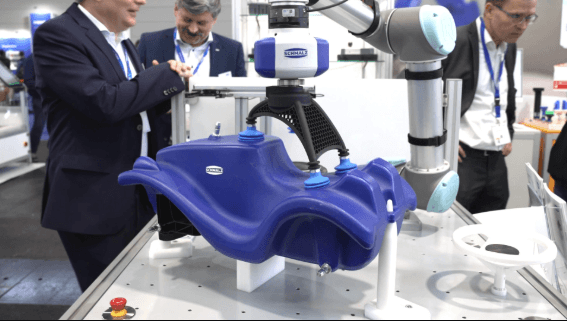
In the landscape of Industry 4.0, the rise of Collaborative Robots (or “Cobots”) has redefined the factory floor. Unlike traditional industrial robots that operate behind safety cages, cobots are designed to work alongside humans, requiring end-of-arm tooling that is both lightweight and inherently safe. Among the various options, the vacuum gripper has become the preferred choice for cobot applications, offering a modular and flexible “hand” that can adapt to a vast range of tasks in real-time.
By integrating smart vacuum technology with lightweight materials, these modular systems allow small and medium enterprises (SMEs) to automate complex pick-and-place tasks with minimal setup time.
The Shift to “Compressed Air-Free” Gripping
One of the most significant innovations in 2026 is the move toward fully electric vacuum gripper units for cobots. Traditional pneumatic systems require extensive hosing and a constant supply of compressed air, which can tether a cobot and limit its mobility.


Advantages of Electric Vacuum Generators
Modern electric grippers utilize miniature onboard pumps to create suction. This offers several key benefits:
- Enhanced Portability: With no air hoses required, cobots can be easily moved between workstations on mobile carts.
- Plug-and-Play Integration: These units often connect via a single cable to the robot’s tool flange, with software “caps” that allow for intuitive programming.
- Energy Efficiency: Electric pumps only consume power when the vacuum gripper is actively holding a part, reducing the overall carbon footprint of the production line.
See also: The Evolution of Augmented Reality: From Sci-Fi Dreams to Everyday Tech
Modular Design: One Gripper, Infinite Configurations
The true power of a modular vacuum gripper lies in its “Lego-like” adaptability. Instead of buying a new tool for every product, operators can swap out individual components to meet the day’s production goals.
- Adjustable Arms: Modular frames allow users to change the distance between suction cups, enabling the same robot to handle a small smartphone casing in the morning and a large tablet screen in the afternoon.
- Interchangeable Suction Cups: Depending on the material, a user can snap on flat cups for cardboard, bellows cups for uneven surfaces, or foam-based pads for porous materials.
- Dual-Zone Control: High-end modular systems feature independent vacuum channels. This allows a single vacuum gripper to pick up two separate parts and place them in different locations, effectively doubling the robot’s throughput.
Safety First: Designing for Human Interaction
Safety is the cornerstone of cobot technology. Because cobots work in close proximity to people, the vacuum gripper must be designed with “collaborative” features. Modern units feature rounded edges and smooth surfaces to prevent snagging or injury.
Furthermore, smart vacuum sensors provide “Part Present” detection. If the vacuum gripper loses suction or the part is bumped by a human worker, the system can instantly detect the pressure drop and trigger a safety stop, preventing the part from falling and causing injury or damage.
Conclusion: Empowering the Agile Factory
Modular vacuum gripper systems have lowered the barrier to entry for automation. By providing a tool that is as flexible as the cobot itself, manufacturers can achieve a level of agility that was previously reserved for manual labor. Whether you are palletizing boxes, assembling electronics, or tending machines, the combination of cobot mobility and vacuum versatility is the key to a future-proof production line.